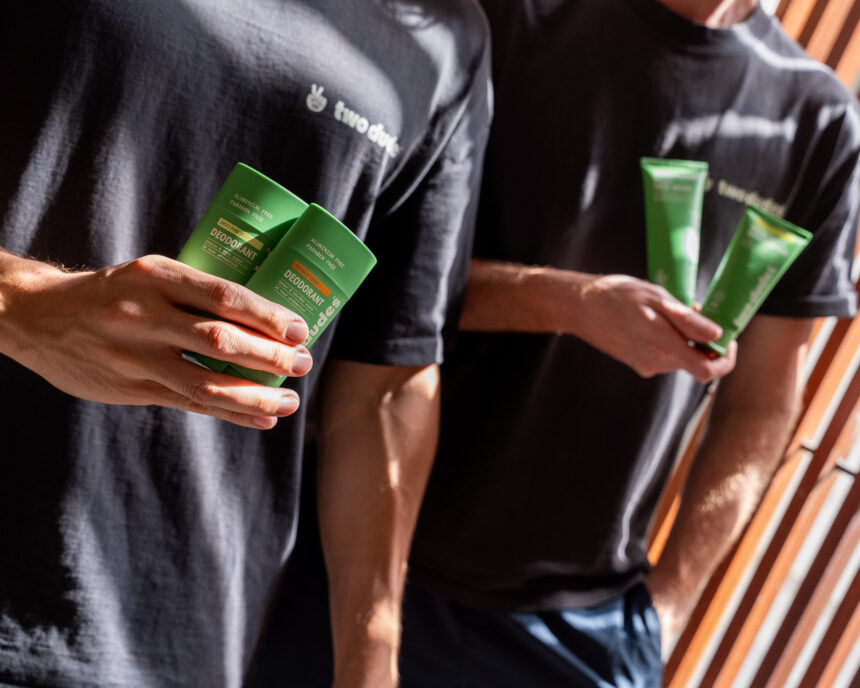
Written by Michael McRae, Co-Founder of Two Dudes
Walk into any major retailer in Australia right now and the gap is obvious the second you compare shelves. The women’s beauty and skincare section is a considered ecosystem, categorised by skin type, skin problem, life stage, and budget; staff are even trained to talk you through it to help you find the perfect product.
Then you hit the men’s section and there’s a singular shelf that’s got a few big brand names doing a men’s version, and the rest of the shelf is sometimes used for more women’s products to fill the empty space. We of course understand that women’s knowledge of skincare is more complex, no one is debating that, but the men’s section behaves like there’s just one type of man and one universal product to suit “all” men.
The brands that will win in the next decade of man-care marketing are the ones that stop treating men as a single customer profile. Skin concerns don’t check for gender at the door; the only thing a 19 year-old dealing with breakouts and a 55 year-old dealing with sun damage have in common is a marketing category that lumped them together for convenience.
What’s also worth differentiating is how these products are packaged and designed. They’ve got dark or grey colours, a “for men” label doing all of the marketing’s heavy lifting and the assumption baked into the shelf that men have one skin type, one need, and a distaste for diversity, apparently.
Aussie men are buying grooming and skincare products in growing numbers; that trend isn’t new, it’s just been chronically underserviced. Brands have been happy to take the sales while doing the bare minimum to earn them; slapping a “for men” label on a product that’s barely differentiated from what’s already on the shelf, package it in blue or black and call it a men’s range.
The approach is less product development and more just relabelling. Compare that to how retail treats women’s beauty products. Nobody would accept a single women’s skincare product covering oily, dry, sensitive, and combination skin under one packaging run. It’d be laughed out of a buying meeting, yet that’s essentially the standard for men’s ranges.
The result is a category that looks healthy on revenue but is quietly leaving growth on the table. Men aren’t buying more because they’re satisfied with the options, but because the alternative is nothing. There’s also a trust problem retail hasn’t reckoned with.
Men are more sceptical of grooming marketing than women are of beauty marketing, largely because they’ve been sold surface-level products dressed up in performance language for years. A 4-in-1 bottle for “all” skincare needs is just like the “all-in-one” shampoo, conditioner and facewash trio that’s typically thrown in as the only men’s shower-care product on the shelf.
The retailers who move first on this won’t need to invent a new customer group, they just need to start treating the one they already have a little more serious. This means catering to a broader male market; real differentiation by skin type and concern, not just bottle colour. It also means enabling workers on the shop floor with the means to actually talk to male customers about their skin and give genuine recommendations, instead of pointing at whatever’s black and masculinely scented.
Long story short, retail figured out decades ago that women need to be marketed to with
detailed specificity, and Australian men have their arms wide open to get even just a slither of that level of thought. The brands willing to give it to them first won’t just win market share, but build the kind of loyalty that comes from finally being taken seriously as a customer, not just a demographic to tick off.